

Updated 1 November 2026 · Reviewed by Steve Clarke, Technical Director at AVolution
If you are budgeting for Council AV in 2026, the honest answer is: it depends heavily on the room, the democratic use case, the level of hybrid participation required, and the procurement route. A small town or parish council may be able to improve a meeting room for under £10,000, while a district, borough, or unitary authority replacing a full council chamber system can easily move into six figures. Multi-room civic centre programmes can exceed £1 million.
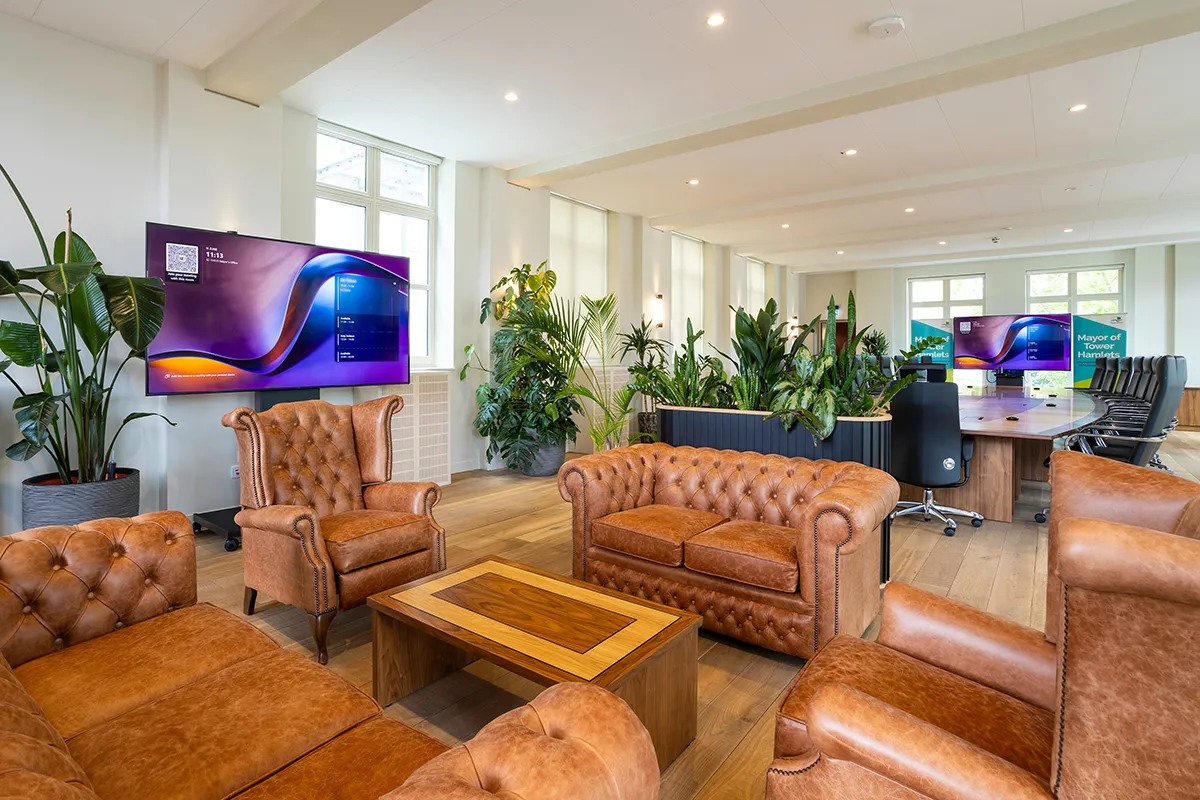
Councils of every size face the same question: how much AV does the chamber really need? AVolution has delivered council projects across that range, from hybrid meeting rooms and digital signage for the London Borough of Tower Hamlets to a modern council chamber and collaboration system for Lichfield District Council. The ranges below reflect that spread, from a single hybrid meeting room to a full democratic chamber.
Quick answer: in 2026 a basic hybrid meeting room typically costs £3,000 to £9,000, a town hall or parish chamber upgrade £8,000 to £60,000, a mid-sized council chamber £35,000 to £150,000, and a full democratic chamber system £100,000 to £250,000+. Civic centre programmes can reach £500,000 to £1.5 million+.
Typical council AV system cost UK ranges in 2026
For planning purposes, most UK councils can think in these broad bands:
These are guide ranges, not fixed prices. A council chamber audio visual equipment cost can change significantly once a supplier surveys the room, checks existing infrastructure, confirms accessibility requirements, and assesses whether old equipment can be reused.
What is included in council chamber AV?
A modern council AV system cost UK estimate usually covers much more than a screen and a few microphones. Public-sector chambers often need to support formal democratic meetings, scrutiny committees, planning meetings, public questions, officer presentations, press attendance, webcasting, and accessible participation.
A complete council chamber AV package may include:
- ✓Chairperson and delegate microphone units
- ✓Wireless or wired conference microphones
- ✓Digital signal processing for echo cancellation and audio routing
- ✓Ceiling, wall, or desk loudspeakers
- ✓Assisted listening or hearing loop provision
- ✓Fixed PTZ cameras for councillors, officers, and public speakers
- ✓Automatic camera switching linked to active microphones
- ✓Large displays or projection for agendas, presentations, and remote participants
- ✓Control panels for democratic services or AV support staff
- ✓Recording and streaming hardware or cloud webcasting services
- ✓Video conferencing integration for Teams, Zoom, or other platforms
- ✓Network switches, rack hardware, cabling, containment, and power
- ✓Security controls, user permissions, and support arrangements
- ✓Training, documentation, testing, and handover
The more the system is expected to automate, the more design, programming, testing, and support time it needs. This is why two rooms with similar equipment lists can have very different costs.
Planning a council chamber upgrade? We survey your chamber for free and send an itemised, fixed-price proposal.
The biggest factors that influence Council AV cost
1. Room size, layout, and acoustics
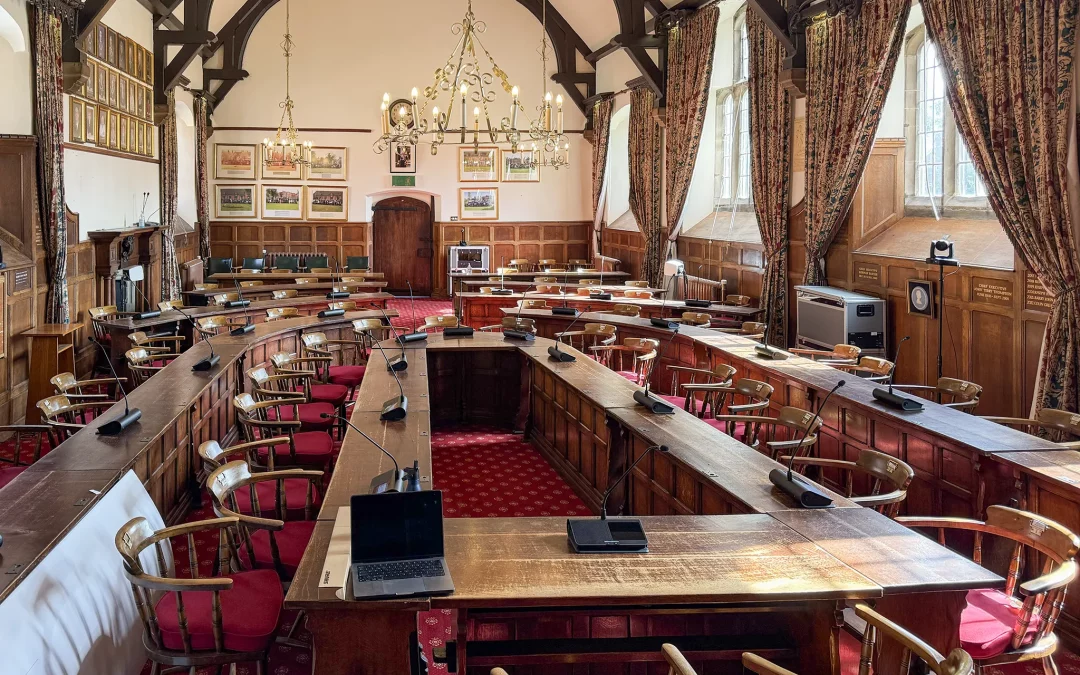
A small committee room can often use an all-in-one camera bar or a small number of table microphones. A formal chamber with curved desks, public gallery seating, multiple officer benches, press areas, and a chair’s dais needs a more engineered solution.
Acoustics are a major cost driver. Historic town halls and civic buildings often have hard surfaces, high ceilings, listed interiors, and reverberant rooms. In those spaces, intelligible speech may require more microphones, better loudspeaker zoning, acoustic treatment, and careful audio commissioning.
2. Number of speakers
The number of councillors, officers, and public contributors directly affects the microphone design. A 12-person meeting room can be served very differently from a 60-seat council chamber. Formal democratic meetings also need microphone discipline, chair control, and sometimes name identification for recordings or streams.
Conference microphone systems cost more than standard meeting-room microphones, but they are often better suited to council environments because they can provide chair override, speaking queues, voting options, and integration with camera tracking.
3. Hybrid meeting requirements
Hybrid room AV is one of the biggest reasons councils are reviewing chamber technology. Even where formal remote attendance rules vary by nation, meeting type, or legislative status, many councils still need rooms that support remote officers, invited speakers, public observers, accessibility needs, training, consultation events, and internal collaboration.
In England, the government consulted on remote attendance and proxy voting at local authority meetings, and sector bodies have continued to campaign for permanent remote and hybrid meeting powers. NALC said in May 2026 that it was disappointed that the King’s Speech did not include measures to permanently enable remote and hybrid council meetings for parish and town councils and local authorities. (gov.uk)
Hybrid functionality adds cost because the room must work for both in-person and remote participants. Remote attendees need to hear every speaker clearly, see the correct camera shot, follow presentations, and avoid echo or feedback. In-person participants need to hear remote speakers without confusion.
4. Webcasting, recording, and storage
Live streaming and recording can be simple or sophisticated. At the low end, a council may stream a single camera feed to a platform. At the higher end, the system may need branded webcasts, agenda item indexing, searchable archives, captions, retention rules, and integration with committee management software.
Storage and governance matter.
5. Accessibility and inclusion
Council AV is not only about convenience. Public meetings must be intelligible and accessible. Costs may include hearing loops or assisted listening, captioning workflows, accessible displays, clear sightlines, accessible control interfaces, and better speech reinforcement for members of the public.
Accessibility can also influence camera positioning, public gallery audio, overflow room feeds, and the way papers or presentations are displayed.
6. Existing infrastructure
One of the most important cost questions is: what can be reused?
If the chamber already has good cabling routes, reliable network connectivity, adequate power, a usable equipment rack, and modern displays, the project may be relatively contained. If the building needs new containment, electrical work, network ports, floor boxes, Wi-Fi improvements, or furniture modifications, costs rise quickly.
Public-sector procurement and the Crown Commercial Service AV framework
When councils ask about the Crown Commercial Service AV framework, they are usually looking for a compliant route to market for AV design, supply, installation, and support. In 2026, it is important to note that Crown Commercial Service became part of the Government Commercial Agency on 1 April 2026, so some buyers and suppliers may now refer to GCA rather than CCS. (webprod.crowncommercial.gov.uk)
The previous Audio Visual Technical Consultancy and Commissioning DPS, RM6225, was extended until 28 February 2026 and the GCA page states there is no replacement DPS agreement, although many services are also covered by RM6116 Network Services 3. Network Services 3 includes network solutions and communication services, including audio and video conferencing, while Network Services 4 is described as giving access to networks, telecommunications services, products, and solutions including audio and video conferencing. (webprod.crowncommercial.gov.uk)
For councils, the practical point is simple: check the current framework status before building the procurement timetable. Depending on scope and value, options may include a suitable GCA framework, a local or regional framework, a further competition, an open tender, or a below-threshold process under the council’s contract standing orders.
The Procurement Act 2023 came into force on 24 February 2025, and current 2026 to 2027 thresholds include £207,720 including VAT for supply or services contracts to sub-central government authorities, which includes local government. (gov.uk)
Capital cost versus whole-life cost
A common mistake is to budget only for installation. Council AV has ongoing costs, including:
- ✓Annual support and maintenance
- ✓Software licences
- ✓Webcasting platform subscriptions
- ✓Cloud storage or archive costs
- ✓Warranty extensions
- ✓Replacement batteries for wireless microphone systems
- ✓Equipment refresh after several years
- ✓Staff training and documentation updates
- ✓Call-out charges for urgent meeting support
Contracts Finder also shows smaller council chamber support arrangements can sit in much lower bands, such as a chamber voting, conference, and recording system contract valued from £0 to £14,999.
How to control costs without under-specifying
The best way to reduce risk is to define outcomes before choosing equipment. Councils should ask:
- 1Which meetings must the system support?
- 2Are remote participants expected to speak, observe, or vote?
- 3Is live streaming required now, later, or not at all?
- 4How many active microphones are needed?
- 5Who will operate the system during meetings?
- 6What accessibility features are mandatory?
- 7What equipment can be reused?
- 8What support response time is needed for statutory meetings?
- 9How will recordings be stored, retained, and published?
- 10What refresh cycle should be assumed?
A phased approach can also help. For example, a council might first improve audio and hybrid meeting reliability, then add webcasting, agenda indexing, or voting later. This avoids overspending on features that are politically desirable but not yet operationally ready.
Final budget guidance
For a straightforward town hall AV or small chamber upgrade in 2026, a sensible starting budget is often £10,000 to £60,000. For a district or borough council chamber where reliable microphones, cameras, streaming, accessibility, and formal meeting control are required, £75,000 to £200,000 is a more realistic planning range. For a full civic centre programme across multiple rooms and buildings, the budget may be several hundred thousand pounds or more.
The safest answer to “how much does council av cost in the UK in 2026?” is therefore: budget by use case, not by equipment list. Start with the democratic requirement, define the accessibility and hybrid model, check the procurement route, and include whole-life support from the beginning. That approach gives members, officers, and residents a clearer view of value for money and reduces the risk of buying a system that is either over-engineered, under-supported, or obsolete too soon.
Council AV projects we have delivered
Case study
Lichfield District Council
A modern council chamber AV and collaboration system for full council and committee meetings.
Case study
London Borough of Tower Hamlets
Hybrid meeting rooms and digital signage to support public services and hybrid working.
Quick links: Council chamber AV installations · Government AV solutions · All case studies · AV installation costs in the UK in 2026
Ready to plan your council AV project?
Tell us how your chamber is used, from full council to committees and public webcasts. AVolution will survey your site and send a clear, itemised proposal.